Corporate Domicile Programs: A New Revenue Model for Sovereign Nations
How tribal nations can leverage their inherent sovereignty to build sustainable, non-gaming revenue streams through entity formation and domicile services.
Tribal nations across the United States are at an inflection point. For decades, gaming revenue has served as the primary economic engine for many communities, funding essential services from healthcare and education to elder care and infrastructure. But increasing competition from commercial casinos, the rise of online sports betting and prediction markets, and the inherent volatility of a single-sector economy have intensified calls for diversification. A growing number of tribal leaders are now looking beyond gaming toward revenue models that draw directly on the one asset no external force can replicate: sovereign authority.
Among the most promising of these models is the LLC domicile program—a framework in which a tribal nation establishes itself as a jurisdiction for the formation and registration of business entities. Rather than manufacturing goods or operating storefronts, the tribe provides a legal home for limited liability companies, corporations, and similar structures, generating recurring revenue through formation fees, annual renewals, and regulatory services. It is, in essence, the same approach that made the state of Delaware a household name in American corporate law—adapted to the unique legal standing of federally recognized tribal governments.
Why Sovereignty Makes This Possible
The legal foundation for tribal domicile programs rests on well-established principles of federal Indian law. Federally recognized tribal governments are sovereign entities whose authority predates the U.S. Constitution. They possess the inherent power to legislate, regulate commerce, and charter business organizations under their own laws. The Supreme Court recognized this status in the foundational Marshall Trilogy decisions of the early nineteenth century, and Congress has repeatedly affirmed it through legislation supporting tribal self-governance and self-determination.
In December 2025, the U.S. Treasury Department and the IRS finalized regulations clarifying that entities wholly owned by tribal governments and organized under tribal law are not recognized as separate entities for federal tax purposes. These regulations confirmed that such entities share the tax status of the tribal government itself. While these rules address tribally owned entities specifically, they underscore the federal government's recognition that tribes can and do exercise lawmaking authority over business organizations formed under their jurisdiction—an authority that extends naturally to hosting third-party entity formations.
Key DistinctionAn LLC domicile program does not grant tax exemptions to the businesses that register. Companies formed under a tribal domicile remain subject to federal income tax just as any domestic corporation would be. The tribe's role is jurisdictional: it provides the legal framework, regulatory oversight, and administrative services for entity formation—not a tax shelter.
The Delaware Model, Reimagined
To understand the opportunity, consider the precedent set by the state of Delaware. With a population under one million, Delaware hosts legal registrations for more than 1.9 million business entities, including over two-thirds of Fortune 500 companies. The state earns hundreds of millions of dollars annually from entity formation fees, franchise taxes, and the professional services ecosystem that has developed around its Court of Chancery and business-friendly legal code. Delaware did not achieve this dominance through natural resources or geographic advantage. It built a superior legal product—a well-drafted business code, efficient filing processes, a responsive regulatory environment, and a body of case law that provides predictability for corporate governance disputes.
Tribal nations can replicate this approach by developing their own commercial codes tailored to attract specific market segments. The Delaware Tribe of Indians has already demonstrated the viability of this model through its Tribal Domicile program, which focuses on reinsurance companies used by vehicle dealerships and specialized producers. That program offers electronic formation processed within seventy-two hours, a single all-inclusive annual fee, and direct access to regulators with no intermediaries required. The growing volume of formations and re-domestications through that program illustrates that the market responds well to jurisdictions that combine regulatory clarity with operational efficiency.
Revenue Mechanics: How the Model Works
An LLC domicile program generates revenue through several streams. The primary source is formation fees—one-time charges paid when a new entity is organized under the tribal commercial code. Second, annual renewal or franchise fees provide a recurring revenue base that grows with the portfolio of registered entities. Third, regulatory and compliance fees apply when entities require certificates of good standing, amendments, mergers, or re-domestications. Finally, there is a secondary economic multiplier as registered agents, attorneys, and service providers establish relationships with the tribal jurisdiction, creating a professional services ecosystem.
The capital requirements for launching such a program are modest compared to large-scale infrastructure projects or gaming operations. The core investments involve drafting a commercial code (typically with the assistance of specialized legal counsel), establishing a filing and regulatory office, building or licensing an electronic filing platform, and training administrative staff. Because the service is fundamentally informational and administrative rather than physical, it scales efficiently—each additional formation adds revenue without proportionate increases in overhead.
Feasibility Considerations for Tribal Councils
Legal Infrastructure
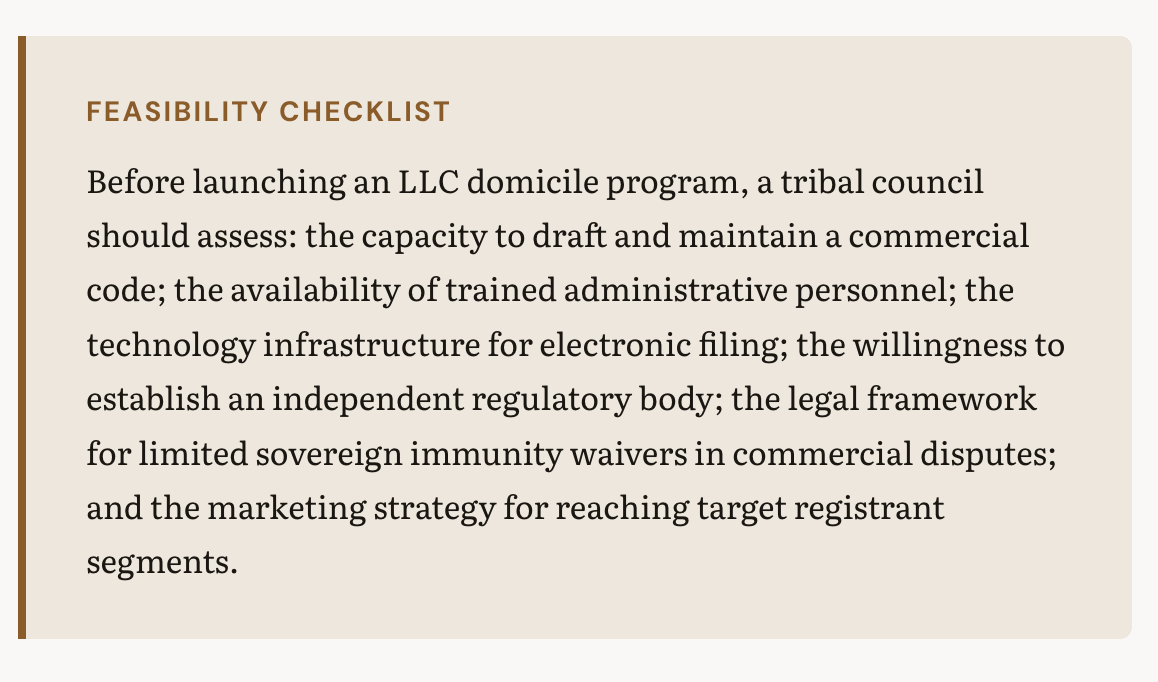
A tribal council considering this model must first evaluate its existing legal infrastructure. A well-drafted tribal commercial code is the cornerstone of the program. This code must address entity formation procedures, governance requirements, annual reporting obligations, dissolution processes, and the rights and responsibilities of members and managers. The code should be publicly accessible, clearly written, and designed to provide the legal certainty that business owners and their attorneys demand when choosing a domicile.
Regulatory Credibility
Market adoption depends on the jurisdiction's perceived legitimacy and reliability. Tribal councils should consider establishing an independent regulatory body or commission—separate from the political apparatus of the tribal government—to administer the program. This separation between governance and business operations mirrors a principle that research on tribal economic development consistently identifies as a predictor of long-term success. An apolitical regulatory body provides assurance to registrants that the rules governing their entities will remain stable and will not shift with changes in tribal leadership.
Market Positioning
Rather than attempting to compete directly with Delaware or Wyoming for general-purpose LLC formations, tribal councils may find greater success by targeting specific market niches. The Delaware Tribe's focus on allied reinsurance companies is one example. Other potential niches include holding companies for real estate investors, single-purpose entities for specific industries, series LLCs for portfolio segmentation, or benefit corporations for social enterprises. A focused approach allows the tribe to develop deep expertise and tailor its code and regulatory processes to the needs of a defined customer segment.
Sovereign Immunity and Waivers
Business registrants will want clarity on how disputes are resolved. Tribal councils should consider establishing a dedicated business court or arbitration mechanism, along with limited, well-defined waivers of sovereign immunity for commercial disputes arising under the tribal commercial code. These waivers can be narrowly scoped to cover only specific types of claims and specific remedies, preserving the tribe's broader sovereign protections while providing the legal predictability that the business community expects.
Alignment with Broader Tribal Goals
The appeal of an LLC domicile program extends beyond direct revenue. It creates skilled administrative and legal positions within the tribal community. It builds institutional capacity in commercial law and regulatory administration—competencies that benefit the tribe's own economic enterprises. It generates revenue that is not tied to consumer spending cycles or seasonal tourism, providing a stable fiscal base that can fund core government services. And it exercises sovereignty in a visible, constructive way that reinforces the tribe's status as a functioning government and economic jurisdiction.
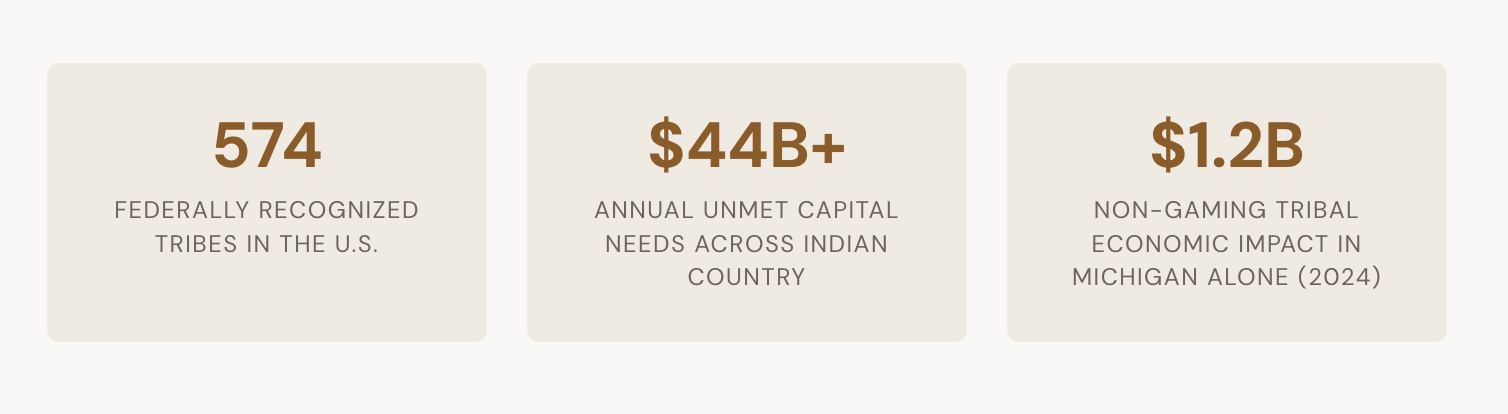
This model also aligns with the broader movement toward economic diversification that tribal leaders across the country have embraced. Michigan's twelve federally recognized tribes, for example, quadrupled their non-gaming economic impact between 2019 and 2024. The Pokagon Band of Potawatomi established Mno-Bmadsen to expand into manufacturing, construction, real estate, and retail. Tribes in Northern California have invested in renewable energy infrastructure. An LLC domicile program represents another frontier in that diversification effort—one that requires relatively low capital investment and leverages the tribe's most distinctive and durable asset.
Looking Ahead
The regulatory landscape has never been more favorable. Federal policy now explicitly recognizes the authority of tribes to charter business entities under their own laws and confirms the tax treatment of those entities. The market for entity formation services continues to grow as entrepreneurship expands and business structures become more complex. And the digital infrastructure required to operate a competitive filing office is more accessible and affordable than ever before.
For tribal councils weighing whether to pursue this path, the fundamental question is not whether the model can work—the Delaware Tribe's program and the broader precedent of state-level domicile competition have already answered that. The question is whether your nation is prepared to invest in the legal, regulatory, and administrative infrastructure needed to execute it well. Done right, an LLC domicile program can provide a durable, scalable, sovereignty-affirming revenue stream for generations to come.